
ANGUS MARBLING 2.0
By Top Dollar Angus, Inc.
March 31, 2026
Introduction
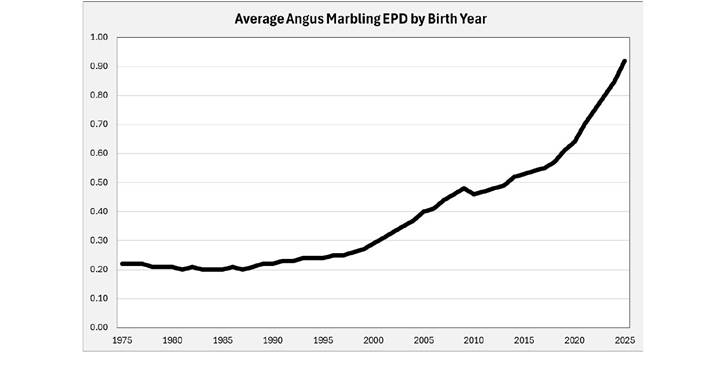
The Angus breed has been steadily increasing its genetic marbling ability for 25 years. For registered Angus calves born in 2025, the average Marbling EPD stood at an impressive 0.92. Expect another step higher with 2026-born calves, followed by another bump up in 2027, and so on.
The 2025 level is more than one-third of a marbling score (+0.39) higher than breed average in 2015. Incredibly, this ten-year, 0.39 EPD increase is three times greater than the 0.13 EPD rise observed between 2005 to 2015. Marbling is not only increasing in the Angus breed; it is increasing at a faster pace than ever before and shows no sign of slowing down.
The top 10% of Current Angus Sires stands today at a Marbling EPD of 1.21. To rank in the top 5%, a 1.41 Marbling EPD is required, while 1.78 achieves a top 1% ranking. These are pace-setting marbling genetics. However, they do not represent a pinnacle for the breed.
There are a small but growing number of Angus bulls and females now meeting and exceeding the 2.0 Marbling EPD threshold, a level unimaginable only a decade ago.
While it might be tempting to write off this small group at the top as an irrelevant extreme, that is not the case. Angus Marbling 2.0 has arrived. Plenty of the highest marbling bulls in the Angus breed are being utilized in artificial insemination, which broadly extends their genetic influence. Over half of all registered Angus cattle are produced each year via artificial insemination or embryo transfer. Angus sires used in artificial breeding are a sign-post for breed direction. And, genetically speaking, where the Angus breed goes, the U.S. beef industry follows.
A sizable percentage of the next generation’s Angus bulls have an elite-marbling sire, which is creating more high-marbling bulls. Their numbers are multiplying rapidly.
Simple math shows that a group of average marbling Angus females (Marbling EPD = 0.57) mated to a top 5% Marbling EPD Angus sire will produce progeny ranking in the top 25% of the breed. These results represent an astounding genetic leap over a quarter of the breed’s population in one generation. The same is true for commercial cows. Top marbling Angus bulls can genetically reposition the progeny of a mediocre marbling cowherd to a point well above industry average in a single calf crop. In the never-ending quest to produce more valuable cattle, such rapid improvement has never before been possible.
Beef Demand Benefits
Increased marbling ability in the U.S. beef industry’s largest breed has positively influenced consumer demand. Select beef represented 30% of the quality grade mix as recently as 2010. Prime and Choice grades accounted for less than 65% that year.
Fast forward to 2025 and Select was down to 13% of all graded beef, while Prime and Choice exceeded 84%. No one even mentions sub-Select beef anymore, which has declined to 3% or less. During early 2026, Select grade percentages dropped into the high single digits, while Prime grading carcasses set new highs.
Consumers responded favorably to improving beef quality offered in the form of well-marbled beef cuts. After struggling in the 1980s and 1990s, beef demand has been on a continual upward trek during the past two-and-a-half decades. The well-followed Cattle-Fax Beef Demand Index hit yet another record in 2025, up roughly 50% compared to 1998–1999.
Better marbling is the cornerstone of better beef demand, and stronger demand positively impacts cattle prices whether supplies are large or small. Other breeds have also increased their marbling genetics, but Angus led the way. The Angus breed deserves significant credit for improving U.S. beef quality, even though other factors (like longer feeding periods) also contributed. The industry’s focus has appropriately shifted from “pounds pay” to “quality pounds pay more.”
Expert Perspectives
To gain additional perspective on factors driving the increase in Angus marbling genetics and uncover what lies ahead in the Angus Marbling 2.0 era, seven cattle and beef industry professionals were asked to answer five questions. These experts represent different parts of the industry and different geographies.
Contributing Experts
- Brian Bertelsen, Vice President, Field Operations, US Premium Beef, Dodge City, Kansas
- Casey Cobb, Friona Industries, General Manager, Dalhart Cattle Feeders and North Texas Cattle Feeders, Dalhart, Texas
- Kenny Hinkle, Owner, Hinkle’s Prime Cut Angus, Nevada, Missouri
- Harold Miller, Owner, 7 Triangle 7 Cattle Company, Akron, Colorado
- Jay Nordhausen, Co-Owner/Manager, Ogallala Livestock Auction, Ogallala, Nebraska and North Platte Stockyards, North Platte, Nebraska
- Doug Stevenson, Owner, Basin Angus Ranch, Reed Point, Montana
- Gary Vandiver, Owner, Bob Vandiver Cattle Company, Richmond, Missouri
Question 1: What is driving selection for increased Marbling in the Angus breed?
| Cobb: The economic structure of grid pricing and related premiums are driving the selection focus on marbling. High-marbling carcasses pay the largest premiums to feeders and producers. |
| Bertelsen: Dollars! Value-based grids and formulas are sending a strong message to cattle feeders, and further up the production chain, that quality pays. Approximately 75% of all fed cattle are currently marketed on grids or carcass-merit formulas. If a rancher still thinks marbling doesn’t matter, 75% of their feedlot customers care a great deal about it! Total animal value is driven primarily by carcass weight and quality grade (marbling). Plus, marbling is not negatively correlated with other traits. That means ranchers can select for improved marbling without sacrificing the other valuable traits important to them. |
| Nordhausen: The biggest force driving selection for increased marbling in the Angus breed is carcass value and grid premiums for Prime and Upper 2/3 Choice. There are other factors which have helped speed up the process, such as the growing use of genomics and the American Angus Association’s selection indexes. It all goes back to dollars. |
| Stevenson: The selection for increased marbling in Angus cattle is simple economics. For a producer that feeds their cattle to finish, premiums paid in recent years for Certified Angus Beef (CAB) and Prime grade carcasses made it an easy decision to add more marbling. Furthermore, genetic selection for increased marbling can increase revenue without a commensurate rise in production costs. |
| Vandiver: What we’re seeing is a combination of market demand and economic incentives. Retailers, food service, and consumers are paying premiums for beef that grades Upper 2/3 Choice and Prime. Marbling is the trait that drives those grades. The motivation is economics and genetics tools are the enabler. |
| Question 1 Summary Selection for increased marbling in Angus cattle is being driven mainly by economics. Grid-based pricing dominates the fed-cattle market, and strong premiums for CAB, Prime, and various other branded programs reward high-marbling carcasses. Modern EPDs, genomic tools, and selection indexes make identifying high-marbling genetics easier and more reliable. Additionally, marbling can be improved without sacrificing other key traits. Because marbling increases carcass value without raising production costs, producers are strongly incentivized to select for it. |
Question 2: What positive outcomes is this trend producing?
| Miller: The first and perhaps most important outcome has been ‘righting the ship’ with beef demand, because of a more consistent taste and eating experience. With high levels of marbling, the opportunity for additional premiums associated with Prime and CAB offers more income on fewer head at the producer level. |
| Bertelsen: Improved consumer demand is the biggest positive outcome for the industry. Marbling drives taste which drives value. Beef has always been the highest-priced protein in the meat case. Now with higher quality, we are worth it! Increased marbling has significantly improved consumer eating experiences and they are willing to pay for it. |
| Vandiver: There are several positives, including larger premiums for fed cattle. More carcasses grading Upper 2/3 Choice and Prime mean more income for cattle feeders. Another plus is improved consumer satisfaction. Better marbling generally improves tenderness, juiciness, and flavor. It also helps beef compete against pork, chicken and other proteins. |
| Hinkle: Ongoing expansion in demand for our product is based on quality [marbling] and has resulted in larger premiums collected by feeders and ranchers. This is a key reason the Angus name is so recognizable both domestically and worldwide. |
| Nordhausen: The most positive outcome of this trend is producing a more consistent, high-quality product for beef consumers. They responded by elevating beef demand to unprecedented levels. |
| Stevenson: The beef industry is experiencing better demand based on the increased demand for Prime and Upper 2/3 Choice beef. Greater availability has allowed more consumers to try the higher end product. Consumers like it and are willing to spend more to buy it. This phenomenon has increased demand across the entire beef industry. |
| Question 2 Summary: Increased marbling has improved beef demand by creating a more consistent, higher-quality eating experience. More cattle now grade Upper 2/3 Choice and Prime, leading to larger premiums for feeders and producers. Higher quality has strengthened consumer satisfaction, boosted consumer willingness to pay higher prices, and helped beef compete with other proteins. For the Angus breed, the shift has enhanced its reputation as the leading source of high-quality, highly-marbled beef. |
Question 3: What are the potential negatives?
| Stevenson: One potential negative is too much emphasis on one trait, which results in less emphasis on something else that is important. Select for increased marbling, but make sure selection pressure is maintained on fertility, structure, efficiency and longevity in the cow herd. |
| Cobb: Single trait selection must be avoided, because it has potential to create unintended consequences. For example, muscle mass and feed efficiency may suffer. |
| Nordhausen: Single-trait selection is never a good choice when making breeding decisions. Are we losing weaning weight, fertility and longevity in the Angus breed? We are feeding cattle longer and pushing them harder than ever. When do we start losing efficiency? When do we start getting too much fat on cattle, externally, seam-fat wise and KPH fat? |
| Vandiver: Over-selection risk. Focusing too narrowly on marbling can unintentionally reduce attention to other important traits, like fertility, structural soundness, maternal ability and overall performance. |
| Miller: The potential for negatives is a paramount risk, IF we follow the path of single trait selection. An antagonism with growth and other traits is possible. Thus, a multi-trait approach to genetic improvement is a must. Growth performance and carcass weight are important to profitability. |
| Hinkle: We must continue to achieve progress in marbling without sacrificing fertility and functionality. We cannot get caught up in single-trait selection. |
| Bertelsen: None, if we’re careful. Even though marbling is not negatively correlated with other traits, many traits impact profitability for ranchers, backgrounders and feeders. We need to stay balanced in genetic selection. High-marbling genetics with low growth still limit total dollar value per head. |
| Question 3 Summary: Over-selecting for marbling can create problems and lead to unintended consequences. Focusing too narrowly on marbling may reduce attention to key traits like fertility, growth, muscle, structural soundness, efficiency and longevity. While marbling itself isn’t strongly antagonistic to other traits, failing to maintain balanced, multi-trait selection can erode overall herd performance and profitability. |
Question 4: What important uses/applications do you foresee for elite marbling Angus genetics?
| Hinkle: One important use is the positive impact high-marbling Angus bulls can make on cowherds with no valuable carcass traits in their genetics. The single-generation improvement of doing this is amazing. |
| Vandiver: Crossbreeding to improve carcass value is one logical application. Even outside straightbred Angus females, high-marbling genetics can be used to boost carcass quality in commercial cow herds. |
| Bertelsen: If a producer needs to do a marbling ‘catch up,’ the tools are available to do so more rapidly than ever before. EPDs work. We have plenty of data to show the strong correlation between sire carcass EPDs and the actual carcass data and grid performance of their progeny. |
| Cobb: Increased qualification for Prime and CAB provides the opportunity to develop supply chain partnerships with packers and retailers. Producers who have known and predictable genetics will be able to participate in and take advantage of these opportunities and capture a larger share of beef’s retail value. |
| Miller: There exists the opportunity for smaller processors to enter the marketplace with a guaranteed, high-quality product where all aspects of production and processing are validated to satisfy consumers. A more sustainable system without the waste of reduced efficiency is possible with genetics for attaining high quality grades at a lighter carcass weight and younger age. |
| Question 4 Summary: Elite marbling Angus genetics can be used to rapidly improve carcass quality in average and low-marbling herds, support branded beef and supply-chain programs, fit low-input systems and help processors deliver consistent premium beef. They also offer potential for more sustainable production by achieving high quality grades efficiently at lighter carcass weights and younger harvest ages. |
Question 5: What will the future bring for marbling in the Angus breed?
| Nordhausen: The future of the Angus breed will include active competition for increased marbling. The superior beef product we are producing will continue to help grow demand and bring in new consumers. As breeders, can we produce cattle that gain more with less feed, have less back fat, yet with increased intramuscular fat? That would be the next summit to reach in the Angus breed. |
| Cobb: The Angus breed has the database and analytical architecture in place to further accelerate its progress. By using technological advances, we can become more precise in our genetic selection. We will likely divide the Prime quality grade into high and low categories to create yet another value-added layer of opportunity. |
| Miller: The future could bring a ‘haves and have nots’ sort regarding the seedstock offered for sale. There will be greater premiums and discounts on cattle at all market levels, reflecting beef value differences at retail and in restaurants. |
| Hinkle: There is no limit on where we can take marbling levels in the Angus breed and therefore the beef industry. We have all the tools at our fingertips. But we must stay disciplined in our genetic selection and not sacrifice the great Angus cow along the way. |
| Stevenson: My prediction is continued increasing demand for high-marbling beef, both in our domestic market and for export. As more consumers have an opportunity to try very high-quality beef, demand will continue to grow. |
| Bertelsen: The financial rewards for marbling are here to stay. The beef industry suffered a significant loss of consumer demand during the 1980s and 1990s. The focus at that time was on lean, low-fat beef production. Since 1997, marbling and consumer demand have increased. Currently, fed cattle with high marbling genetics have more flexibility in marketing (wider marketing window). |
| Question 5 Summary: Marbling in the Angus breed will keep increasing as demand for high-quality beef keeps growing. Genetic tools will make selection efforts more precise, creating larger price differences between top-end and bottom-end cattle. The industry may add new premium tiers, reward predictable high-marbling genetics, and see stronger alignment between genetics, management and marketing. The challenge will be boosting marbling while maintaining efficiency, fertility and cow functionality. |
The Future of Angus Marbling 2.0: Industry Implications
1. Marbling Will Continue to Be a Central Focus
Our experts believe that demand for highly marbled beef—domestic and export—will keep growing. The Angus breed is well positioned to help meet that demand. The industry is still far from producing ‘too much’ marbling, mainly because there are plenty of low-end cattle that need improvement and more consumers that need to experience high-quality beef.
2. Genetic Progress Will Accelerate
With more high-marbling sires, strong databases and advanced genomic tools, breeders will become more precise and successful in selecting for marbling. Elite marbling Angus breeding stock are a genetic game changer by enabling faster progress than ever before in history. Any breeder, whether seedstock or commercial, large or small, that desires better marbling genetics can move their cattle way up the bell curve in a single generation.
3. Market Differentiation Will Intensify
As carcass value becomes more transparent, the industry will see a distinct divide between high-value and low-value genetics. Premiums and discounts will widen, rewarding cattle that truly perform on the rail and penalizing those that do not.
4. Greater Alignment Across the Supply Chain
Producers, feeders, and packers will increasingly coordinate their efforts around predictable, high-quality cattle. Procurement strategies will favor known, high-end genetics, and quality grades may subdivide further (e.g., high-Prime vs. low-Prime) to capture even more value.
5. Protecting the Angus Cow Remains Essential
While marbling potential is virtually unlimited, breeders must avoid sacrificing maternal traits. The experts believe it is possible to improve marbling without compromising cow functionality—but doing so requires disciplined breeding programs.
6. Strong Economic Incentives Will Persist
Marbling-driven premiums are expected to remain a major profit driver. High-marbling cattle offer marketing flexibility: cattle feeders can sell early or feed them longer depending on market conditions, and still achieve strong quality grades.
7. Elite Marbling Sires Used in Beef x Dairy Cattle
Many high-marbling Angus and Angus-based sires are already being utilized to make superior beef x dairy cattle. More of this is expected in the years ahead. Beef x dairy cattle are almost entirely the product of artificial insemination. With only minor differences in semen cost between the best and average sires, a growing number of dairy producers will use elite Angus/Angus-based sires to enhance the value of their beef x dairy calves.
8. Angus Marbling 2.0 to Impact Other Breeds
Multiple other beef breeds routinely incorporate Angus genetics into their registered seedstock. Examples include Red Angus, Brangus, SimAngus, Balancer and LimFlex. Such genetic-acquisition efforts will continue, possibly even accelerate. These breeds can also benefit from improved marbling ability. Therefore, many of the Angus sires they select will include those with ultra-high Marbling EPDs.
9. Elite Marbling Angus Re-packaged with Greater Overall Balance
Critics may suggest that elite-marbling Angus are not adequately balanced with other important EPD and non-EPD traits. This criticism is both valid and not valid at the same time. Some high-marbling Angus sires and sire lines are relatively well balanced for a large number of economically important traits. Others need improvement. Going forward, Angus breeders will work diligently to create large numbers of elite-marbling, well-balanced seedstock.
Conclusion
The future of marbling in the Angus breed includes further genetic gains, greater mating precision and continued strong economic rewards. As genetic tools improve and consumer demand for premium beef grows further, the beef industry will become more differentiated, more aligned and more focused on producing cattle that combine exceptional eating quality with performance, efficiency and functionality.
Elite marbling sires will drive continued genetic progress in the Angus breed and throughout the industry. Their ability to dramatically elevate marbling in average and below-average commercial herds will be more widely leveraged, reducing the number of low-value cattle entering U.S. packing plants and raising overall beef quality.
Appendix: Case Study
What happens when a Top 3% Angus Marbling EPD bull is mated to a cow with poor marbling genetics? Progeny marbling potential should significantly improve, correct? Yes, and that is exactly what happened in a recent case study conducted by Top Dollar Angus.
A Continental-breed cow was DNA tested with Igenity Beef®. She scored only 4 out of 10 for marbling. Igenity Beef uses a 1–10 reporting system, with higher scores indicating better genetics for the measured trait. The industry average marbling score is 5 to 5.5 out of 10. Therefore, a score of 4 is below the mean of the U.S. cattle population.
We mated this low-marbling female several times with a Top 3% Marbling EPD Angus bull. Our objective was to measure the improvement in progeny marbling genetics. Three half-blood Angus calves were eventually produced and each calf was tested with Igenity Beef. All three calves sired by the high-marbling Angus bull showed much-improved marbling potential, scoring 8 of 10.
| Animal | Igenity Beef Marbling Score | Industry Rank |
| Cow | 4 | Below Average |
| Calf 1 | 8 | Well Above Average |
| Calf 2 | 8 | Well Above Average |
| Calf 3 | 8 | Well Above Average |
The takeaway from this small-scale study is precisely what our contributing experts predicted. Elite marbling Angus genetics can produce tremendous genetic advancement in one generation. Low-marbling cattle are leap-frogged ahead, with their progeny landing well above industry average. That is the power of Angus Marbling 2.0.

To learn more about Top Dollar Angus, contact:
Tom Brink • (303) 478-4331 • tom@topdollarangus.com
Nate Smith • (620) 546-4839 • nate@topdollarangus.com
Cory Priest • (254) 715-3197 • cory@topdollarangus.com
[/vc_column_text][/vc_column][/vc_row]
From the seedstock and cow/calf producer all the way to the feedyard, Top Dollar Angus works endlessly to help you profit from high-value genetics.
John & Patty Tebelius share their thoughts and success on Top Dollar Angus
John and Sheri Hester have been long time believers that using superior genetics makes not only their program more profitable, but also gives those feeders who purchase their cattle the best return on dollars invested as well. Earlier this month that exact scenario played out once again when the Hester Family marketed their Top Dollar Angus verified calves through Torrington Livestock Auction in Torrington WY. Even in a completive market like Torrington with less than 36hrs notice buyers still showed that verified superior genetics are truly worth more.
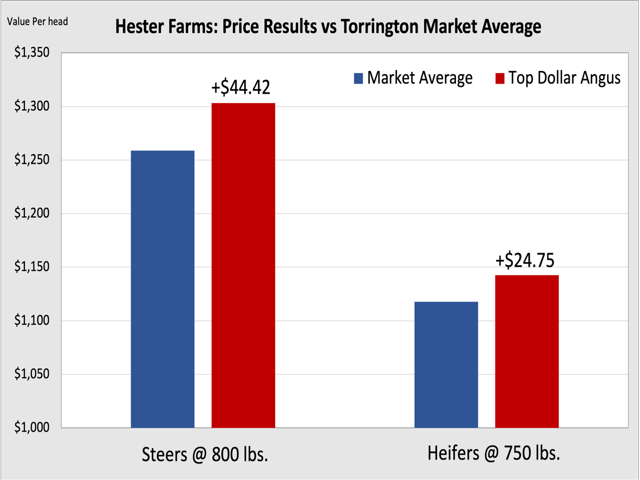
After running statistical analysis considering lot size, sex and weight of cattle sold the Hester’s 200 steers achieved a $44.42 premium per head with their 106 head of heifers bringing $24.75 per head above the average for the day. That makes for a grand total of $11,507 of additional income for the day. While Top Dollar Angus cannot take full credit for these premiums it is safe to say the Top Dollar Angus team’s hard work promoting these cattle added value to the Hester’s offering. Congratulations to the Hester’s on a successful sale day and once again providing a great example of what Top Dollar genetics can do for the commercial cattlemen.
–
Top Dollar Angus Seedstock Partners Sell Angus Bulls at Higher Prices
Analysis of 298 Angus bull sales held from January-April this year uncovered a financially important fact. Top Dollar Angus Seedstock Partners sold bulls for $1,027 more per head, on average, versus non-Top Dollar Angus Seedstock Partners. See summary information below.
Angus Bull Price Comparison:
Top Dollar Angus Seedstock Partners $6,485 average bull price (42 sales)
Non-Top Dollar Angus Seedstock Partners $5,458 average bull price (256 sales)
Difference in average price $1,027 per bull
Note: This price difference is statistically significant (P<0.001).
Data Source: Sale summary information came from sale reports on the AAA website.
The explanation for such a large difference is two-fold. First, Top Dollar Angus genetics (bulls with top 25% growth and carcass EPDs) are in greater demand by commercial cattlemen. Ranchers prefer these bulls and are generally willing to pay more to own them. They desire premium bull genetics because they know the value of their calf crops will increase.
Second, by being a Top Dollar Angus Seedstock Partner, the superior genetics in the sale offering are third-party verified and differentiated in a positive manner to prospective buyers. A bright light of recognized excellence is shown on the entire bull offering, and especially on those individual bulls which are Top Dollar Angus-qualified and that carry the well-known Top Dollar Angus logo in the sale catalog. Of course, the Top Dollar Angus feeder cattle program is part of the package too.
Astute seedstock producers constantly seek to meet the demands of commercial cattlemen, and by doing so can improve their own results on sale day. Top Dollar Angus Seedstock Partners understand this and have aligned their genetics with what commercial buyers demand. They are being rewarded accordingly. Top Dollar Angus does its part by making sure they stand out in the crowded field of bull sellers. It’s a win-win situation backed up by real-world results.